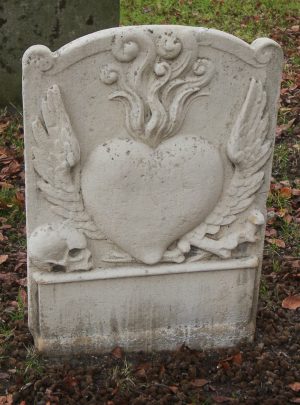
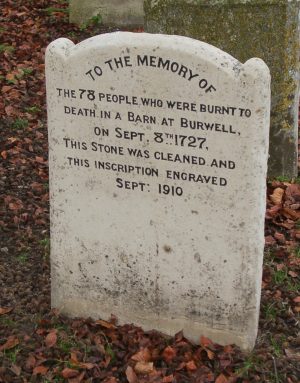
Fire at Burwell - 1727
|
"Seventy six perished immediately and two more died of their wounds within two days." "The fire was occasioned by the negligence of a servant who set a candle and lanthorne in or near a heap of straw which lay in the barn. The servant's name was Richard Whittaker, from the parish of Hadstock in Essex, who was tried for the fact at an assize held in Cambridge on 27 March 1728 but was acquitted."
Three young children from my family died in the fire, and as I continued my research, I discovered a newspaper report dated 19th Feb. 1774 [47 years after the fire] - it reads as follows: "Deathbed Confession; a report reveals that an old man who died a few days ago at a village near Newmarket who just before his death seemed very unhappy. He said he had a burden to disclose. He then confessed that he had set fire to the barn at Burwell on Sept. 8th 1727, when no less than eighty persons unhappily lost their lives. He said he was an Ostler at the time, and that having an antipathy to the puppet showman, was the cause of his committing that diabolical action attended with such dreadful consequences." No name was published in the article, and a short note in the "Fenland Notes and Queries" supposes that Richard Whittaker was wrongly acquitted, but suggests delirium as he was nearing death. Written by Jean Matthews in about 1980 for the Peterborough FHS journal |
23rd-24th Oct 2026

Events Calendar
Burwell Museum Cambridge Events Visit Ely
burwellvillage.org.uk
Events Page
Local Area
Events (Skiddle)


























































Now Online

Project and
Current Status
(350 new homes)
410 Homes
now approved
Linden Homes
Web Site
Flagship Homes
 Police spend £800k on protests at dog-breeding site
The policing of planned protests at the facility is "impartial and proportionate", the force says.
 Civil War sieges dragged ordinary folk into war, says curator
Once the walls were breached, towns were sacked and people treated badly, says curator.
 Chippy to retire after 50 years of frying
Jamie Stott is looking forward to time with the grandchildren and more time playing golf.
 Watch: Presenter announces departure live on-air
Susie Fowler-Watt will anchor BBC Look East for the last time in December.
 Quadruplet capybaras born at wildlife park
The four capybaras are settling into their new home with mum Pepita, the wildlife park says.
 Cambridge professor lifts world tiddlywinks crown
Prof Patrick Barrie has home advantage as he beats Dave "The Dragon" Lockwood of the US in a pub.
 Fallen tree blocks trains to Stansted Airport
Passengers are being told not to travel between Broxbourne, in Hertfordshire, and the Essex terminal
 BBC Look East presenter to leave after 35 years
Susie Fowler-Watt says it has been a "privilege" to have "grown up" alongside audiences.
 Sexual misconduct cases at ambulance service double
The East of England Ambulance Service says reported cases of "sexual safety" more than quadrupled.
 Fire at proposed asylum seeker housing treated as arson
Crews from Cambridgeshire and Norfolk attend the fire at Roman Court.
 Cadet leader admits sexual offences against boy
Rylan Ray is on trial accused of further sexual offences, many involving children, which he denies.